The Golden Thread by Joscelyn Godwin
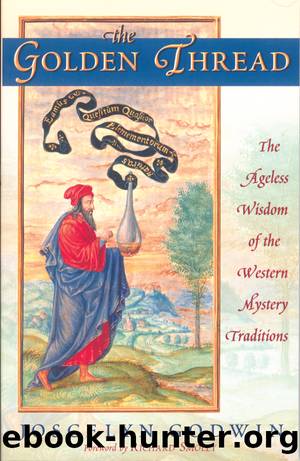
Author:Joscelyn Godwin [Godwin, Joscelyn]
Language: eng
Format: epub
Publisher: Quest Books
Published: 2007-12-15T00:00:00+00:00
CHAPTER
12
The Philosopherâs Dilemma
In every generation there have been a few people who did not believe so much as know some of the answers to the eternal questions of humanity.1 Their knowledge is notoriously difficult to convey to the rest of us, but its radiance and certainty act as a beacon and a reminder of what a man or woman may be. In an ordered and traditional society, there is a place for them: like Catherine of Siena or Nicholas of Cusa,2 they command the respect of kings and popes, and set a standard of holiness and wisdom to which the clergy (if not insanely jealous) aspire. But what do they do when the spiritual equilibrium of the world falls apart, as it did during the fifteenth century with the East-West schism and the influx of humanism; in the sixteenth, with the Reformation, Counter-Reformation, and Wars of Religion; and in the seventeenth, with the witchcraft mania, the Thirty Yearsâ War, and the scientific revolution?
The evidence points in two directions. Some of the Wise made efforts behind the scenes toward the healing and renovation of society. Others worked to bring illumination to individuals. The first are visible in Rosicrucianism at the beginning of the seventeenth century; the second, who will be treated in the next chapter, in alchemy and theosophy.
The philosopherâs dilemma is the choice between these two fields of action, the political and the personal. It may be phrased thus: Can the state of humanity as a whole be remedied, or is it in such a parlous case that remedy is only possible on the individual level?
One does not have to be excessively wise to be troubled by this question, but to answer it requires a sounding of oneâs deepest convictions about human nature and the place of man on earth. For example, does one believe that life on earth is merely a prelude to a much more important life that begins after death? If so, the social conditions of this vale of tears are a secondary matter, even a distraction. Does one believe, with most Christians, that everyone has an individual and immortal soul, or, with some pagans, that personal immortality is won only by titanic efforts? Is there a clear distinction between material and spiritual existence, or are body and soul both part of a continuum that is split by our misperception? Should I concern myself with humanity as a whole, or with my own salvation, leaving the rest to Divine Providence or the goddess Fortuna? Am I a separate unit with my own spiritual history, a stranger or even exile on this earth (the Gnostic point of view), or do I belong to a tribe, race, or species with a macrohistory of past and future evolution?
In the sixteenth century there were three main doctrinal streams in Europe whose business it was to spare people the trouble that such questions cause. Catholics were advised to leave weighty theological matters to the Church, as agent of Godâs will on earth, and to try to live a virtuous life according to her teachings.
Download
This site does not store any files on its server. We only index and link to content provided by other sites. Please contact the content providers to delete copyright contents if any and email us, we'll remove relevant links or contents immediately.
Professional Troublemaker by Luvvie Ajayi Jones(29753)
Empire of the Sikhs by Patwant Singh(23199)
Twilight of the Idols With the Antichrist and Ecce Homo by Friedrich Nietzsche(18774)
Plagued by Fire by Paul Hendrickson(17534)
The Sun and Her Flowers by Rupi Kaur(14626)
Norse Mythology by Gaiman Neil(13562)
Fangirl by Rainbow Rowell(9457)
A Journey Through Charms and Defence Against the Dark Arts (Harry Potter: A Journey Throughâ¦) by Pottermore Publishing(9334)
Adultolescence by Gabbie Hanna(9017)
Wonder by R.J. Palacio(8710)
Tools of Titans by Timothy Ferriss(8589)
Becoming Supernatural by Dr. Joe Dispenza(8366)
How to Bang a Billionaire by Alexis Hall(8275)
Wonder by R. J. Palacio(8237)
Crystal Healing for Women by Mariah K. Lyons(8003)
The Road Less Traveled by M. Scott Peck(7726)
The Lost Art of Listening by Michael P. Nichols(7615)
The Witchcraft of Salem Village by Shirley Jackson(7433)
The Institute by Stephen King(7150)
